
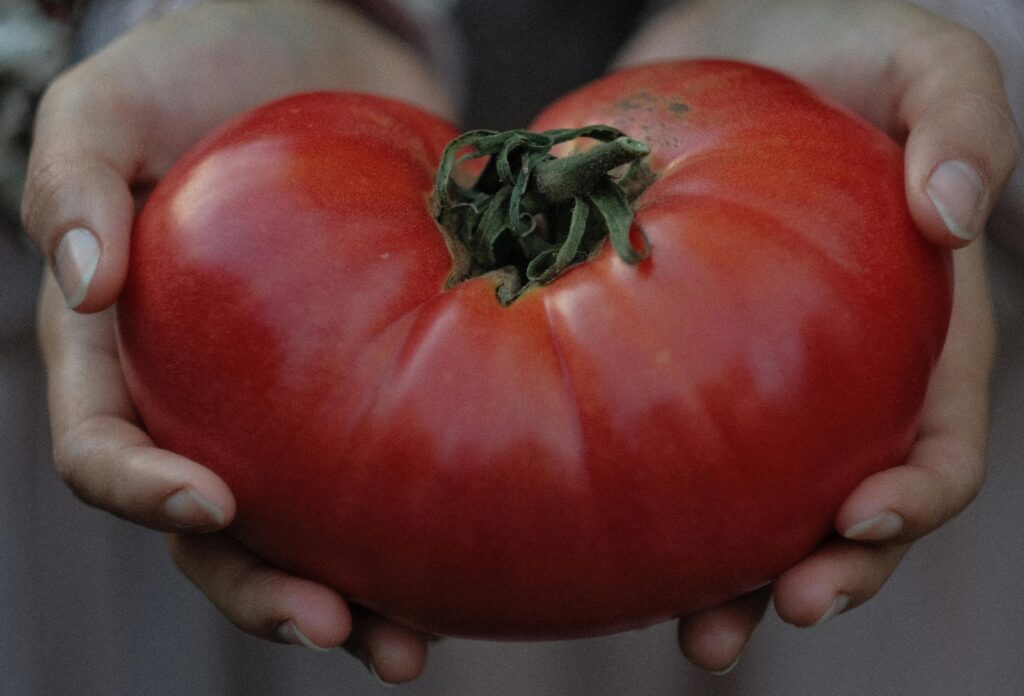
Growing Brandywine tomatoes is often described as a high-stakes gamble.
When you win, you win the tastiest prize in the gardening world! When you lose, you’re left with cracked fruit, yellowing leaves, and a lot of frustration.
Because Brandywines are an older heirloom variety, they lack the “armor” that modern hybrids have. They haven’t been bred for disease resistance or thick, travel-ready skins. They are can be quite delicate and occasionally difficult.
However, most Brandywine “failures” are actually predictable patterns that can be managed with the right knowledge. It’s not a mystery!
This guide covers the 10 most common Brandywine problems gardeners will face. More importantly, we discuss how to fix these issues before they ruin your harvest.
1. The Number One Enemy: Cracking
If you’ve grown Brandywines before, you’ve seen this. You have a beautiful, nearly ripe tomato, and after a heavy rain, it splits open like it’s bursting at the seams.
Why it happens
Brandywines have incredibly thin skins, especially compared to the volume (size) they often grow to. When the plant receives a sudden surge of water (like a heavy summer thunderstorm), the inside of the fruit expands faster than the skin can stretch and BOOM – a big old crack appears.
- Radial Cracks: These run from the stem down the sides.1
- Concentric Cracks: These form circular rings around the top of the fruit.2
The Solutions
- Consistent Watering: Use a soaker hose or drip irrigation to keep soil moisture levels steady. Aim for about 1–1.5 inches of water per week.
- Mulching: Apply a thick layer of straw or wood chips around the base of the plant to prevent the “seesaw” effect of soil drying out and then getting soaked.
- Don’t Over-Fertilize: High nitrogen late in the season can cause a growth spurt that leads to cracking.
- The “Pick Early” Trick: If you see a heavy rainstorm in the forecast, pick any tomatoes that have started to “blush” (change color). They will finish ripening on your counter and stay crack-free.
2. Slow Growth and Late Ripening
If you planted your Brandywines at the same time as your Cherry tomatoes, the cherries could be ready in July, but the Brandywines are still green in August.
This also applies to other varieties of Tomatoes that are early producers – it’s even an issue with other fruits and vegetables in the garden.
Why it happens
It’s simply in their DNA. Brandywines are “late-season” tomatoes, requiring 80 to 100 days to reach maturity.3 If you live in a cooler climate with a short growing season, this can be a yearly balancing act. Race against the first frost, but plant late enough that they survive the last frosts. Growing is tough!
The Solution
- Start Early: Start your seeds indoors 6–8 weeks before the last frost.4
- Black Plastic Mulch: In the spring, lay black plastic over your soil to trap heat. Brandywines love warm “feet.” Other mulch works well too for this effect.
- Choose the Sunniest Spot: Brandywines and other large varieties need a full 8 hours of direct, unobstructed sunlight to generate the energy required for those massive fruits.
3. Blossom End Rot (BER)
This looks like a dark, leathery, sunken patch on the bottom (blossom end) of the tomato. It’s heartbreaking to see on a fruit that took 90 days to grow.
Why it happens
BER is a calcium deficiency, but it’s rarely because there isn’t enough calcium in the soil. Usually, the plant just can’t move the calcium to the fruit fast enough because of inconsistent watering.
The Solution
- Stable Soil Moisture: Again, mulch and consistent watering are your best friends.
- Test Your pH: If your soil is too acidic (below 6.0), the plant can’t “unlock” the calcium. Aim for a pH of 6.2 to 6.8. You can grab a simple test kit on Amazon to check your pH, and some soil amendments if you need them (to raise and stabilize pH).
- Remove Affected Fruit: Once a tomato has BER, it won’t go away. Pluck it and toss it so the plant can redirect its energy to healthy fruits.
4. Fruit Drop (Where are the tomatoes?)
Your plant looks huge and healthy, it’s covered in yellow flowers, but the flowers just shrivel up and fall off instead of turning into tomatoes.
Why it happens
This is usually temperature stress. If daytime temperatures stay above 90°F or nighttime temperatures stay above 75°F, the pollen becomes sterile. Conversely, if it’s too cold (below 55°F), the plant goes into “survival mode” and drops its flowers. There are some varieties like Texas Wild which thrive in the higher temperature, but most don’t like it that hot.
The Solution
- Shade Cloth: If a heatwave hits, use a 40% shade cloth to drop the temperature around the plants by a few degrees.
- Be Patient: Once the weather moderates, the plant will start setting fruit again.
- Avoid Over-Nitrogen: Too much nitrogen produces a massive green bush but very few flowers.
5. The “Flop”: Plant Falling Over
A Brandywine Tomato’s vine can get big….really big. Because the fruits are so heavy (often over 1 lb each), a standard “cone” cage from the hardware store will crumple under the weight.
The Solution
- Heavy Duty Staking: Use 8-foot T-posts or “cattle panels” to create a trellis.
- The Florida Weave: This is a commercial method using stakes and twine to “sandwich” the plants upright. You can check out a video showing the method below.
- Early Support: Don’t wait until the plant is falling over to support it. Install your trellis the same day you put the plants in the ground.
6. The “Blight” Battle (Diseases)
Brandywines are susceptible to the “Big Three” fungal diseases: Early Blight (brown spots with rings), Late Blight (greasy gray patches), and Septoria Leaf Spot.7
Prevention & Treatment
| Disease | Identification | Solution |
| Early Blight | Targets lower leaves first; target-shaped spots. | Prune bottom leaves; use copper fungicide. |
| Late Blight | Rapidly turning leaves/stems black; can kill in days. | Remove plant immediately; avoid overhead watering. |
| Septoria | Tiny circular spots with dark borders. | Improve air circulation; mulch to prevent soil splash. |
7. Common Pests
- Tomato Hornworms: These giant green caterpillars can defoliate a Brandywine overnight. The best fix? A flashlight and a bucket of soapy water. They glow under UV light!
- Aphids: Tiny bugs on the undersides of leaves. Just blast them off with a sharp stream of water from the hose.
- Whiteflies: Use yellow sticky traps near the plants to monitor and catch these flying pests.
8. Leaf Curl: Stress or Sickness?
If your Brandywine leaves are curling up like a taco, don’t panic! You can fix this!
- Physiological Leaf Roll: This is just a reaction to high heat or dry wind. The plant is trying to conserve moisture. It doesn’t hurt the yield.
- Viral Leaf Curl: If the leaves are also yellowing, stunted, or mottled, it might be a virus. Check for pests (which spread viruses) and remove the plant if growth stops entirely.
The video below from Luke at MIgardener.com is a gold mine – talking to the different kinds of leaf curl and issues surrounding them. Check it out and check out their seeds!
9. Sunscald
Because Brandywines have such large, heavy fruits, they sometimes weigh down the branches and expose the fruit to direct, blistering afternoon sun. This creates a “bleached” white patch on the tomato.
The Solution
- Preserve Foliage: Don’t get too aggressive with pruning. You need those leaves to act as a natural umbrella.
- Shade Cloth: Again, a bit of afternoon shade can save your fruits from “sunburn.”
10. The Disappointment: Poor Flavor
You finally harvest a Brandywine, you’ve been growing it ALL SEASON LONG, and it tastes… okay. Not bad, not amazing. Just okay.
Why it happens
- Picked Too Early: Brandywines need to be fully ripe (often a deep pinkish-red) for the sugars to develop. The sugars play a huge role in the flavor.
- Too Much Water: If you water heavily right before harvest, you “dilute” the flavor. The tomato can be saved by dehydrating/ drying a bit before eating.
- Refrigeration: Never, ever put a Brandywine in the fridge. It destroys the texture and the volatiles that create that signature aroma.
General Troubleshooting Tips
- Keep a Journal: Note when you see the first spots or when the first fruit sets. This helps you predict patterns next year.
- Take Photos: It’s much easier to diagnose a problem with a clear photo than a description. We like using AI chats to store pictures and background info we can go back to later.
- Accept the “Heirloom Look”: A Brandywine will never look as perfect as a plastic-wrapped grocery store tomato. A few scars and bumps are normal—that’s where the flavor lives! Remember, Heirloom Tomatoes = Function > Form.
Conclusion
Yes, the Brandywine Tomato is a garden diva. It cracks, it gets sick, and it takes its sweet time. But once you slice into that first 1.5-pound fruit and taste the incredible complexity, you’ll realize that all these “problems” are just small hurdles on the way to the best sandwich of your life.