
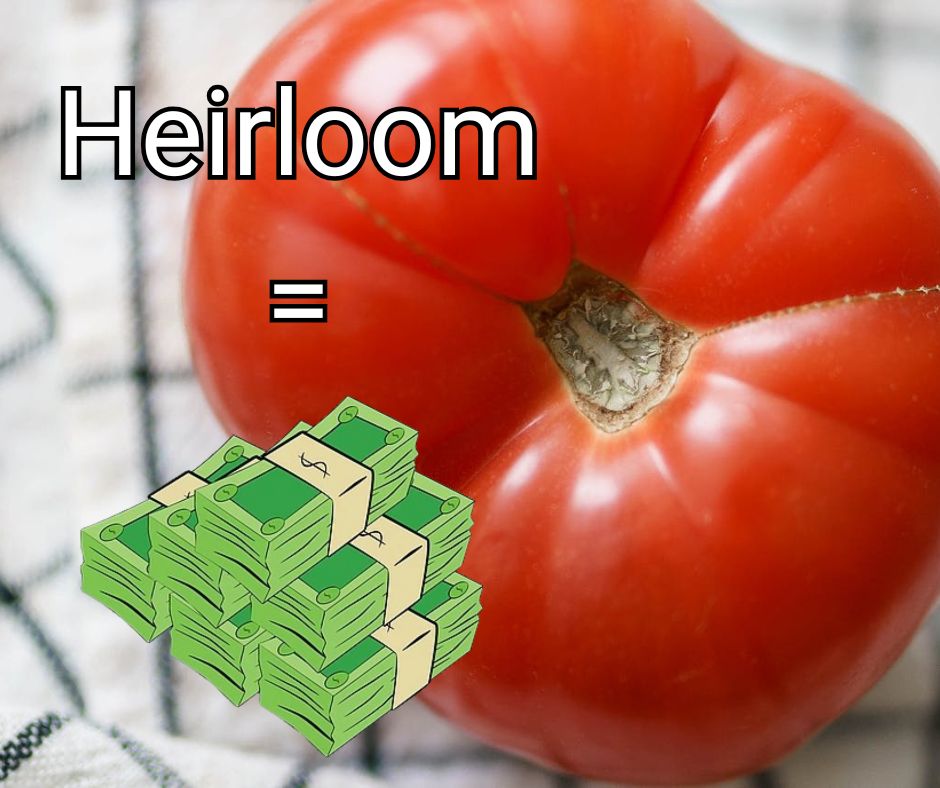
You’re strolling through your local farmers market on a sunny Saturday morning. You see a bin of heirloom tomatoes: deep pink, slightly lumpy, and incredibly fragrant. You grab a couple, head to the scale, and realize they’re $7.00 or $8.00 per pound.
At the grocery store down the street, standard red globes are $1.99.
The variety you’re likely looking at is the Brandywine. Often cited as the best-tasting tomato in existence, it carries a premium price tag that can make even a foodie flinch. But is it just “heirloom hype,” or is there a legitimate reason for the cost?
The truth is, the high price of a Brandywine isn’t arbitrary—it’s a reflection of the sheer difficulty of bringing this “diva” of the garden to your table.
1. The Luxury of Time: Longer Growing Windows
In the world of commercial farming, time is literally money. Most hybrid tomatoes found in grocery stores are “early” or “mid-season” varieties, meaning they go from transplant to harvest in about 60 to 70 days.
Brandywines are the “slow food” of the tomato world. They typically require 80 to 100 days to reach maturity. This means a farmer has to water, weed, and protect that plant for an extra month before seeing a single cent of profit. In that extra 30 days, the plant occupies valuable garden real estate that could have been used for a second crop of something else.
2. Low Yields: Quality Over Quantity
If you look at a commercial hybrid plant, it’s often dripping with fruit—sometimes 30 to 40 pounds per plant. Brandywine plants are much more stingy. You can expect a yield of only 10 to 20 pounds per plant in a good year.
Because the plant produces fewer fruits, each individual tomato represents a larger share of the farmer’s overhead (soil, water, labor). To make the same income as they would growing a high-yield hybrid, the farmer must charge more per pound.
3. The “Diva” Factor: High Maintenance
Brandywine tomatoes are notoriously difficult to grow. They aren’t “set it and forget it” plants.
- Massive Vines: They are indeterminate growers with heavy fruit, requiring robust, expensive trellising or heavy-duty staking.
- Cracking and Catfacing: Their thin skins are prone to “cracking” if the watering isn’t perfectly consistent. They also suffer from “catfacing” (scarring at the blossom end) more than almost any other variety.
- Disease Susceptibility: Unlike modern hybrids bred for resistance to wilt and blight, Brandywines are vulnerable. A single rainy week can wipe out an entire crop.
4. They Are Terrible Travelers
You will almost never see a true Brandywine in a standard supermarket chain. Why? Because they have paper-thin skin and high juice content.
Standard commercial tomatoes are bred for thick skins so they can survive being bounced around in a truck for 1,000 miles. If you put a crate of ripe Brandywines in a semi-truck, you’d arrive with a crate of tomato soup. Because they bruise and leak so easily, they must be sold locally and handled with “white glove” care, which adds to the logistical cost.
5. The Flavor Premium
At the end of the day, people pay $8.00 a pound because of the taste. A Brandywine offers a perfect balance of acid and sugar with a creamy, “beefsteak” texture that a watery, cardboard-tasting supermarket tomato simply cannot replicate.
In the culinary world, this is a specialty product. Much like a dry-aged ribeye or a craft bourbon, you are paying for a sensory experience that mass-production models have sacrificed in favor of shelf life.
6. Small-Scale Production
Brandywines don’t play well with industrial agriculture. They require hand-harvesting and individual inspection. This means they are almost exclusively grown by small-scale organic farmers or market gardeners. These smaller operations don’t have the “economies of scale” that big agricultural corporations do, so their prices naturally reflect the higher cost of manual labor and sustainable practices.
Is It Worth It?
The answer depends on your perspective:
- As a Buyer: If you are making a fresh Caprese salad or a simple tomato sandwich, yes. One taste and you’ll understand the hype.
- As a Grower: It’s a labor of love. It can be frustrating, but the reward is the literal “gold standard” of gardening.
- For Market Gardeners: It’s a “destination” crop. People will come to your stall specifically for the Brandywines, even if they complain about the price!
The Ultimate Hack: Grow Your Own
If you want to enjoy Brandywine flavor without the “market tax,” the solution is simple: grow them yourself. While they are finicky, the ROI (Return on Investment) is staggering.
| Item | Estimated Cost |
| Seed Packet (approx. 25-50 seeds) | $4.00 |
| Potential Yield (per 5 plants) | 75 lbs |
| Retail Value (at $7/lb) | $525.00 |
When you grow them yourself, your cost per pound drops to roughly:
$$\frac{\$4.00 \text{ (seeds)} + \text{supplies}}{\text{yield}} < \$0.50 \text{ per lb}$$
Beyond the savings, there is a “priceless” satisfaction in eating a tomato that is still warm from the sun, knowing you bypassed the expensive market markup.
Conclusion
Brandywine tomatoes are expensive because they are a gamble for the farmer and a luxury for the consumer. The price reflects the time, the low yields, and the delicate nature of a fruit that refuses to be industrialized.
If you’ve never tried one, treat yourself to a pound this summer. It might just change your definition of what a tomato is supposed to be.
Ready to try your hand at growing these “Pink Queens”? Check out our [Ultimate Brandywine Growing Guide] to learn how to manage their diva-like tendencies and get a massive harvest!
CTA: Have you ever grown Brandywines? Tell us in the comments if you think the flavor is worth the effort!